- No. 688, Jinji Road, Xiangzhou, Guangdong, China

Large appearance part stamping dies feature precise structural design and processing, delivering products with no wrinkles or indentations to meet customer appearance requirements.
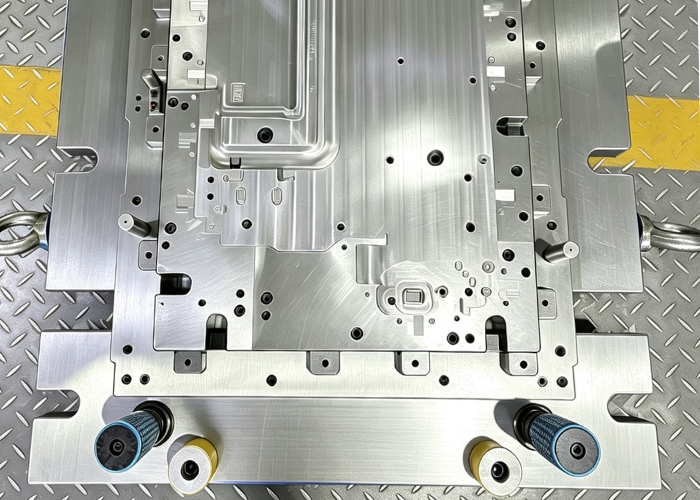
Demand for large‑scale, high‑precision sheet metal stamping is primarily concentrated in large cosmetic and structural parts for air conditioners, refrigerators, dishwashers, lithium battery enclosures, and energy storage cabinets.
We offer large injection molds for cosmetic parts as well as large sheet metal stamping dies up to 10 tons in weight, covering a wide spectrum of home appliance categories including white goods, personal care, environmental appliances, and kitchen appliances. We particularly excel in products with large forming dimensions and demanding surface quality requirements, such as dishwasher panels and other PCM‑coated cosmetic parts.
We are deeply experienced in the new energy sector, mastering core technologies for large sheet metal stamping dies for lithium‑ion battery enclosures – encompassing CAE simulation, deep‑drawing processes, and precision manufacturing. We deliver high‑precision, long‑life die solutions widely serving the power battery and energy storage industries.
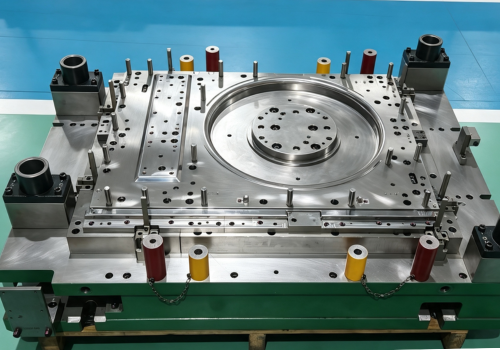
The product material is PCM pre-coated steel sheet. After stamping and forming, the part is directly assembled, and the appearance requirements are strict: no wrinkles, indentations, or forming scratches on the surface.
Control mold assembly clearances within ±0.02 mm.
Apply coating treatment to mold components to reduce friction and improve surface quality.
• The product meets all customer 2D drawing dimensions and assembly requirements.
• The product achieves the required appearance – free from wrinkles, indentations, and forming scratches.
Integrated CAE Simulation & Precision Stamping Process Solutions
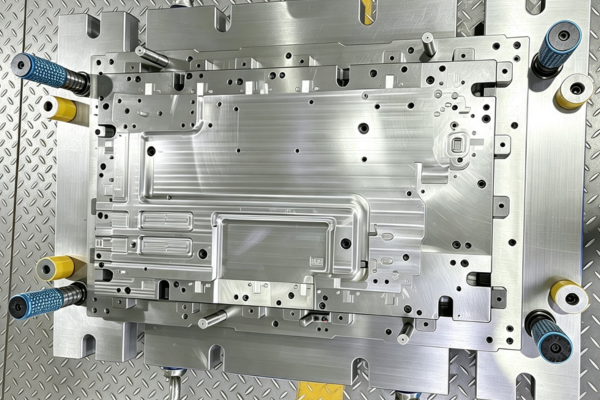
Key controls for the large front‑panel die: CAE analysis for reinforcing ribs to prevent flow marks; a four‑step hole‑flanging process (punching → drawing a pre‑bulge → re‑punching → flanging) to avoid cracking; assembly hole tolerance ±0.3 mm.
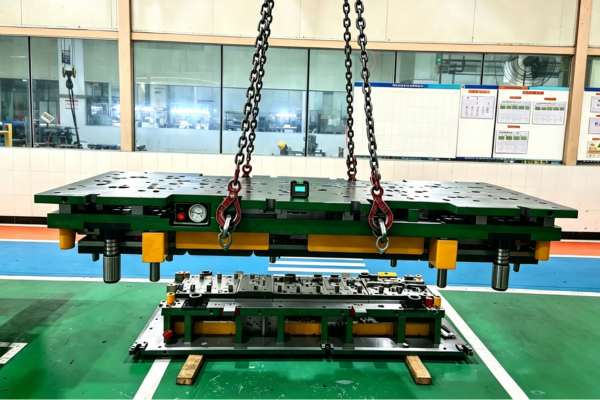
Top‑cover die: angled relief on the female die to reduce side forces; male die height increased by 0.2 mm to allow adjustable bulge height; CAE‑based reverse calculation of the trim line, followed by laser tryout before final die cutting; engraved marks must be clear and undamaged; standard slides for side piercing; blanking die uses coil‑fed shear‑cutting.
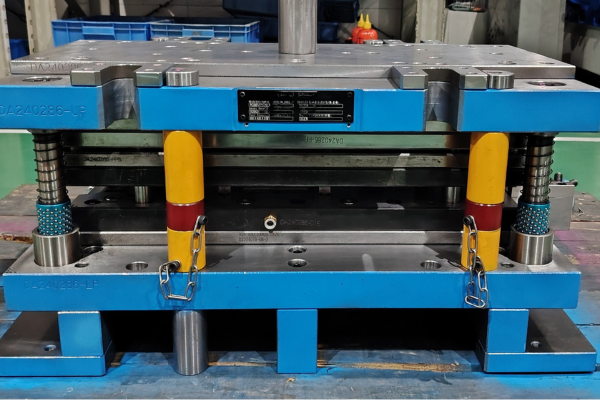
The sheet‑metal die for the decorative panel must ensure a wrinkle‑free and burr‑free surface, use CAE analysis to verify formability and springback of the large arc, and guarantee smooth assembly of the mounting clips without distortion.

Produced on an 800T hydraulic press with robot transfer; the outer curling feature must meet roundness specifications.

CAE analysis is conducted to verify the springback amount at the radius corners and to ensure no material buildup at the corners.
We offer turnkey large die solutions, from product design to mass production, and has earned broad market recognition. The company holds multiple international system certifications including ISO9001, and serves globally renowned clients such as Gree, Daikin, VALEO, and DENSO.
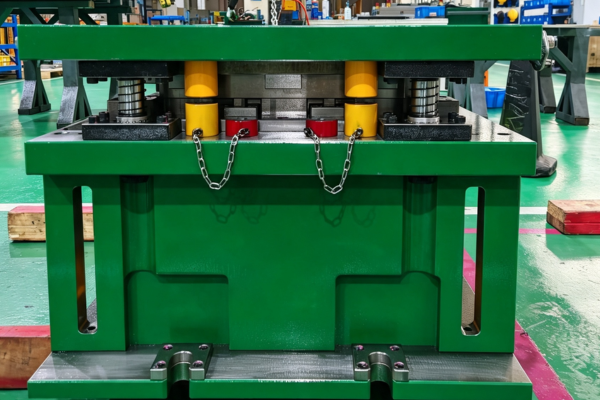
In conventional die designs, operators must load and unload parts inside the press, which presents safety hazards. GDM adopts a movable lower die configuration, allowing part loading and unloading to be performed outside the press, thereby enhancing operational safety.
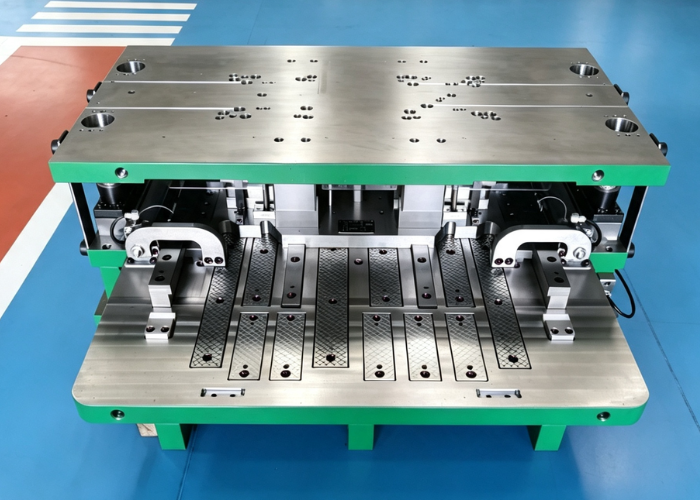
Riveting dies are widely used in industries such as home appliances, electronics, and automotive components, particularly in applications that require high‑strength, weld‑free joining of multiple metal parts.
Typical applications include precision riveting of air conditioner outdoor unit chassis and compressor screws, ensuring reliable compressor fixation during long‑term operation; and multi‑point clinching of pressure cooker insulation cover assemblies, guaranteeing structural stability and sealing performance under high‑temperature, high‑pressure conditions.
Applications include insert riveting of electrical control boxes and nuts, providing a robust mounting base for subsequent PCB or terminal block assembly; as well as micro‑riveting of electronic connectors and terminals, meeting the dual requirements of electrical conductivity and mechanical strength in precision electronic products.
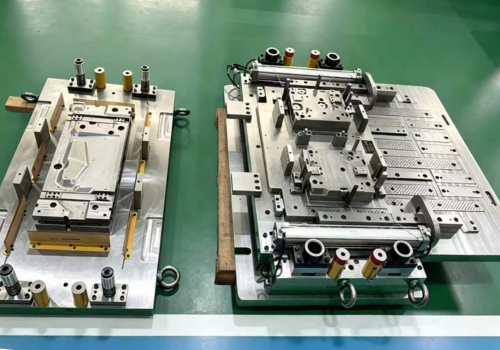
Automatically eject the lower die out of the press to allow product placement outside the press.
Using cylinders connected to the lower die, together with position sensing devices for the movement sequence, achieved through precise mold structure design and machining processes.
• The automatic ejection mechanism meets the customer’s requirements for safe production operation.
• The ejection mechanism operates smoothly, with stable pneumatic pres.
Riveting dies are commonly used in home appliance, electronics, medical and other industries. Typical applications include riveting for air conditioner base pans and feet, compressor screws, electrical boxes with nuts, and thermal insulation cover assemblies of pressure cookers.
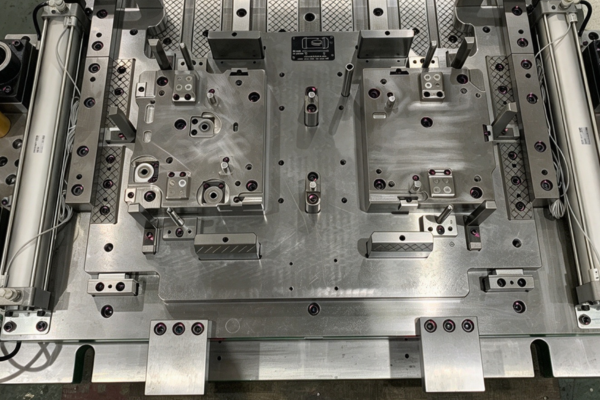
The cylinder is connected to the lower die together with a positioning sensor for motion sequence. With precise mold structural design and machining process, the automatic ejection mechanism runs smoothly. Connected to the press air circuit, it maintains stable air pressure with no jamming and achieves accurate positioning.
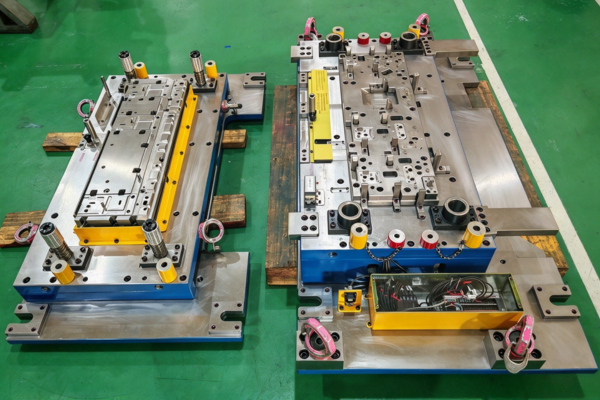
Sensors are installed at each component position on the lower die of the indoor unit mold to verify correct part placement. The sensor detection system operates smoothly and interlocks with the press circuit for precise operation, improving operational safety.
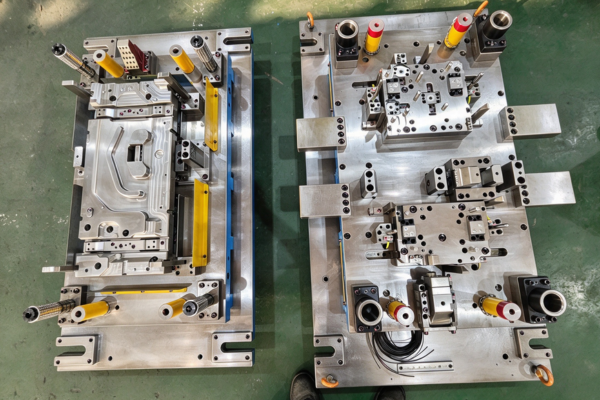
If parts are missing or incorrectly placed on the lower die, the press will detect the abnormality and stop automatically. GreeDaikinMold adopts in-die part detection with circuits interlocked with the press and one-touch control. For manual operation, this prevents missing or misplaced parts, boosting production efficiency and extending mold service life.
Riveting dies for home appliance and automotive parts assembly feature cylinder-driven automatic ejection and one-key pneumatic control, enabling safe loading/unloading outside the press for both efficiency and operator safety
Large deep-drawn sheet metal parts require multiple drawing and restriking operations through several sets of dies and hydraulic press equipment to achieve the final geometry. The key aspects of deep drawing lie in the material’s forming limit, the drawing ratios for multiple operations, as well as the die structure and lubrication factors.
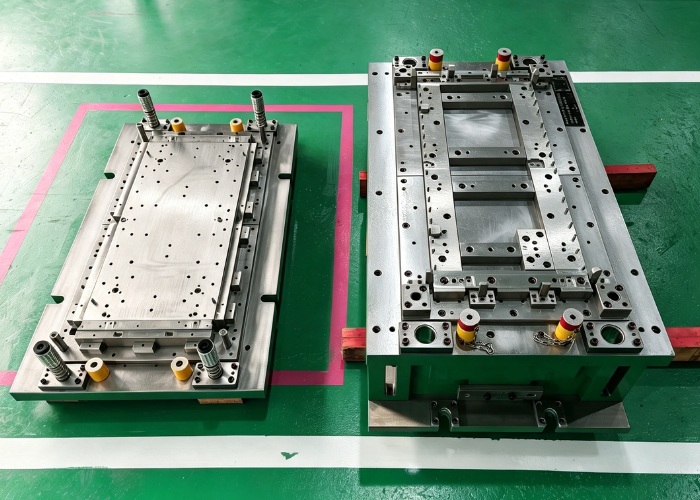
Applied to AC outdoor units, refrigerator side panels, washer drums, and dishwasher panels. Using PCM pre‑coated steel, requiring scratch‑free, orange‑peel‑free, coating‑free surfaces. CAE optimizes material flow and blank holding with nitrogen gas springs, ensuring flatness and gloss consistency for large parts.
Applied to air fryer baskets, rice cooker steamers, and pressure cooker pots – deep‑drawn parts with high depth, thin walls, prone to cracking/wrinkling. CAE springback analysis and multi‑step drawing + sizing ensure dimensional stability and sealing precision under high depth‑to‑diameter ratios, with food‑grade surface quality.
Applied to electric toothbrush bases, hairdryer housings, and shaver charging cradles – precision micro‑parts. Demanding micron accuracy and long die life. Precision guiding and high‑speed stamping designs control thinning, ensure consistent dimensions and gloss across mass production, meeting consumer‑electronics inspection standards.
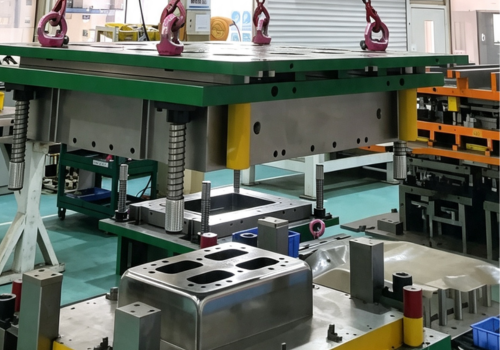
Achieve wrinkle‑free drawing, no invisible cracks, and clear contour lines on the sidewall.
Through CAE analysis, the blank holder force was determined, and the thinning ratio was controlled below 20%. Processes such as drawing, restriking, and side restriking were applied.
• The dimensional tolerance of the protrusions is controlled within ±0.2 mm.
• The product meets the appearance requirements — no wrinkles, no invisible cracks, and clear contour lines on the sidewall.
Gree Daikin offers large deep‑drawing die solutions, using CAE and precision manufacturing to ensure defect‑free forming and stable dimensions for complex stamping parts.
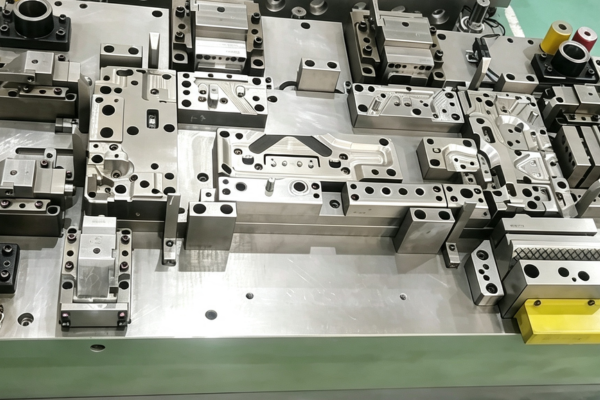
Use angled relief on the female die to reduce side forces; increase male die height for adjustable bulge; reverse‑calculate trim line via CAE and cut after laser tryout; apply profile radius for height differences below 10mm; use slide insert for side tapping/piercing.
The air fryer basket is formed by drawing on a 315T hydraulic press, with strict control to ensure no visible surface defects or burrs. CAE analysis is used in advance to verify the formability of both drawing and sizing operations, thereby optimizing process parameters and ensuring stable dimensional accuracy and satisfactory surface quality
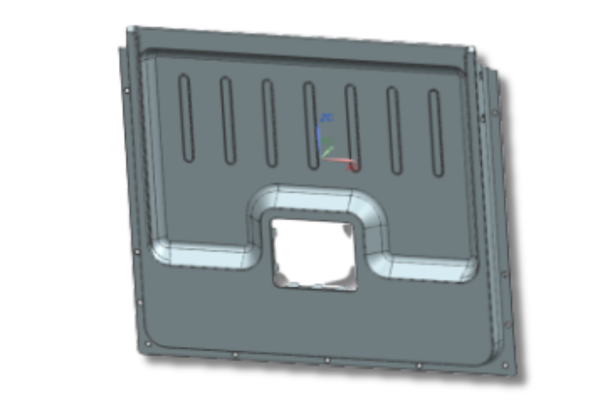
Full‑perimeter undercut triangular ribs without surface defects or seams; 176mm deep draw with no cracking, concavity, or wrinkling; CAE determines M1 drawing and M2 sizing parameters; positioning boss O.D. tolerance ±0.1mm; side undercut uses profile side pusher.
Use angled relief on the female die to reduce side forces; increase male die height for adjustable bulge; reverse‑calculate trim line via CAE and cut after laser tryout; apply profile radius for height differences below 10mm; use slide insert for side tapping/piercing.
The air fryer basket is formed by drawing on a 315T hydraulic press, with strict control to ensure no visible surface defects or burrs. CAE analysis is used in advance to verify the formability of both drawing and sizing operations, thereby optimizing process parameters and ensuring stable dimensional accuracy and satisfactory surface quality
Full‑perimeter undercut triangular ribs without surface defects or seams; 176mm deep draw with no cracking, concavity, or wrinkling; CAE determines M1 drawing and M2 sizing parameters; positioning boss O.D. tolerance ±0.1mm; side undercut uses profile side pusher.
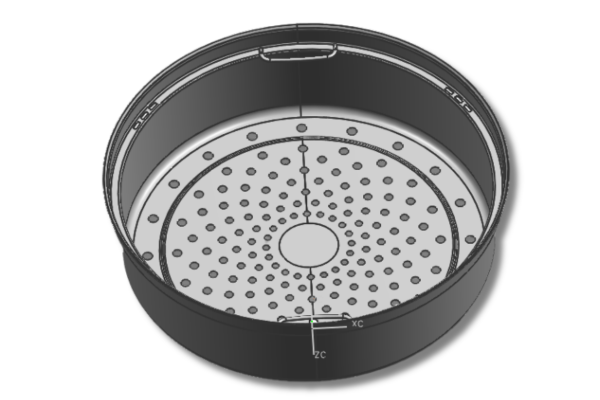
The rice cooker steamer is formed by drawing on a 315T hydraulic press. Strict control over surface quality is required during production to ensure no visible defects or burrs. CAE analysis is conducted in advance to verify the formability of the one‑step drawing and subsequent sizing operations, thereby optimizing die and process parameters to achieve stable dimensional accuracy and satisfactory surface finish.
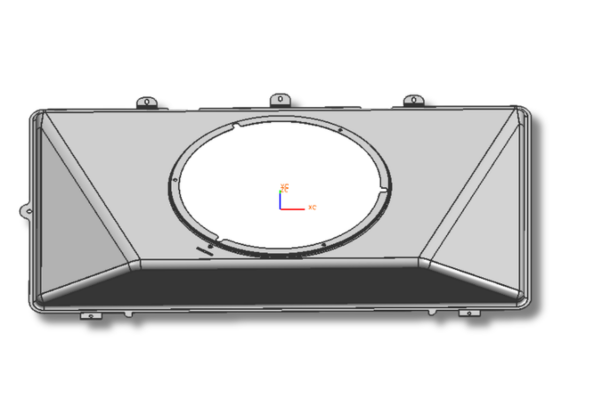
The part is formed by drawing on a 500‑ton hydraulic press. CAE analysis is conducted to verify formability – one‑step drawing forming ensures a defect‑free surface with no visible imperfections or burrs.
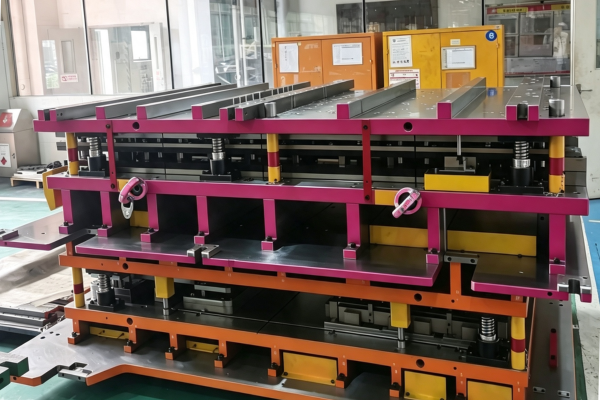
For complex‑surface cavities, angled relief is provided on the female die to reduce lateral forces. The trim line is reverse‑calculated through CAE analysis, followed by laser tryout validation before final trimming die manufacturing.
The original single-process stamping dies result in low production capacity and cannot meet market demand. By utilizing a dedicated press combined with a 3D transfer feeding system or an automatic blank picking mechanism such as a robotic arm, the product can be fed and produced automatically, thereby improving production efficiency.
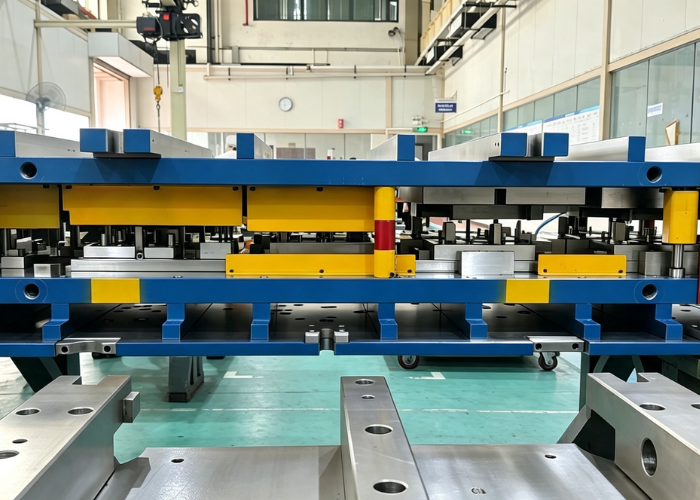
The transfer die is ideal for multi‑process forming of large or irregular sheet metal parts, with robotic arms transferring workpieces between stations for efficient automated production.
Large cosmetic parts such as AC outdoor chassis, front panels and washing machine panels – transfer dies eliminate strip‑connection deformation, ensuring smooth, mark‑free surfaces for high‑volume production.
Structural and interior parts like reinforcing beams and instrument panel skeletons, made of HSS or aluminum – transfer dies combined with automated lines precisely control springback to meet stringent quality standards.
3C electronics and medical equipment – transfer dies reduce manual intervention, increase cycle rates, and support intelligent manufacturing.
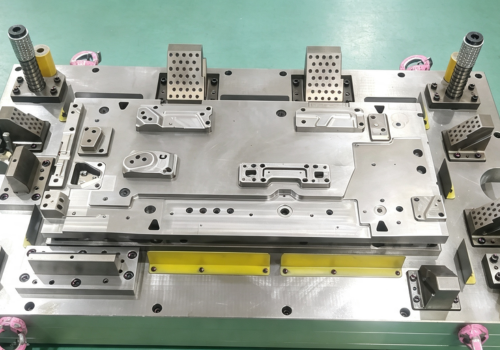
Control product tolerances within ±0.2 mm.
Through precise strip layout, die structure design, and machining processes, the overall height and feeding height of the four dies were made consistent. This ensures stable and accurate pick‑and‑place by the transfer mechanism, with no vibration at each station.
• The 3D transfer mechanism picks and places parts accurately and smoothly, with no interference between the dies.
• Production speed meets the requirement of 20 SPM (strokes per minute).
• Using a 3D transfer system in a single press reduces the number of press machines and labor input while improving production efficiency. This solution has been highly recognized by the customer in their production environment.
With over 36 years of extensive experience in appliance die applications, we deliver stable, high‑precision automated production solutions for large and complex sheet metal parts.
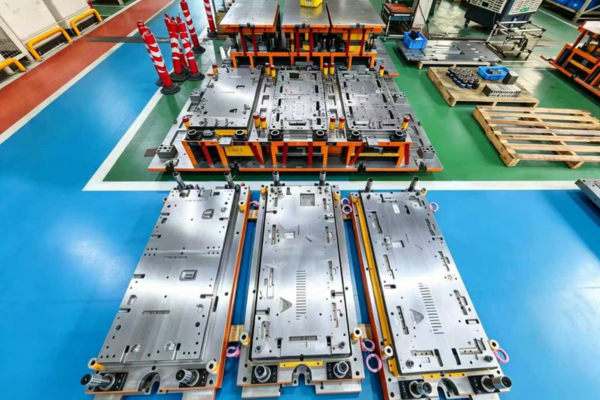
6 single‑operation dies in 3+3 robotic transfer line. CAE validates M1 boss deformation and springback. Bend/emboss areas defect‑free. Stable in‑die positioning meets high‑speed automated handling requirements.
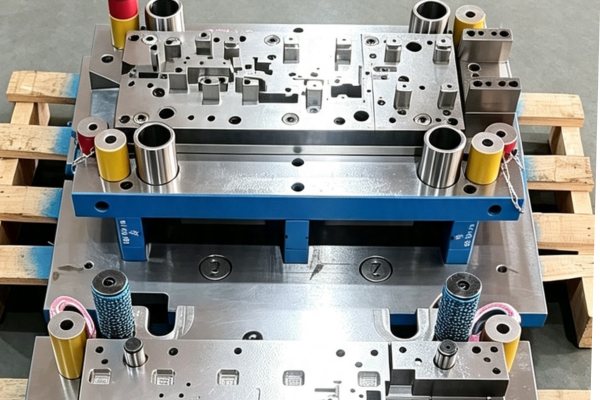
Wall‑mounted part requires no warpage, sharp edges, scratches, or wrinkles. Triangular ribs crack‑free, hemming corners without material accumulation. CAE verifies M1 boss deformation. 3D embossed markings for clear identification.
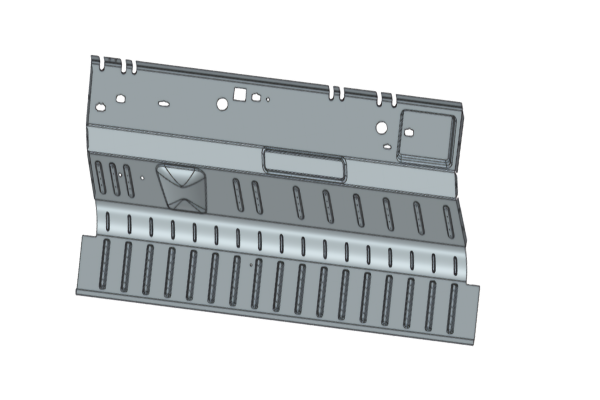
Product >1m with 0.25mm thickness – complex forming. CAE validates one‑step boss forming and springback. Strict surface control ensures no cracking, wrinkling, or burrs, meeting dimensional accuracy and surface quality for large thin‑walled parts.
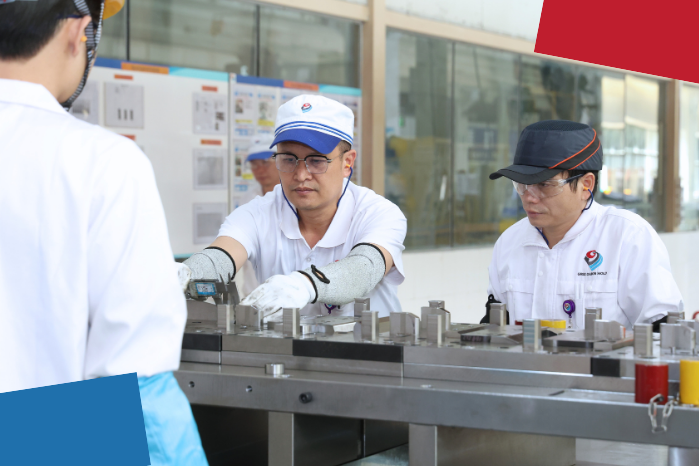
Tell us your needs, and we will engineer a customized precision die for you. – we’ll get back to you within 24 hours. Your information is secure and will only be used for project consultation.
